- How the design thinking process can solve team problems
How the design thinking process can solve team problems

Working in a large organisation with over 100+ employees? Learn how to communicate visually, boost productivity, and stay on brand, at scale. Get in touch(opens in a new tab or window).
Consider this: You work for an organization in East Africa. The organization sells treadle pumps (used for farmland irrigation) to local farmers. After years of operation, you notice that in some regions, the treadle pumps sell extremely well, while in other regions, they don’t sell at all. You’ve been tasked with generating sales of the pumps in those weak-performing regions.
What is your strategy?
Maybe they just aren’t aware of the product. You might try to increase your marketing efforts in those regions, hire new sales reps, or offer a discount. But you would potentially be risking time, money, and energy on a tactic that doesn’t have a clear reason behind it.
Instead, use design thinking. Design thinking is a different way of approaching problems that will help you determine why the product is not selling in a certain region and what you can do to change that.
Table of contents
What is design thinking, and why should you use it?
Design Thinking(opens in a new tab or window) is a problem-solving framework. Unlike other brainstorming methods(opens in a new tab or window), design thinking uses empathetic observation to focus on human-centered needs first before diving into ideation.
The process of design thinking is derived from the methods that designers, architects, and engineers all use to do their work. This framework is used to discover and develop solutions to problems that may or may not actually be design-specific.
The concept has been around for decades, but in the past five to 10 years, IDEO, a design consultancy, has championed the process as an alternative to a purely analytical approach to problem-solving.
Tim Brown, executive chair of IDEO, defines the design thinking(opens in a new tab or window) approach like this:
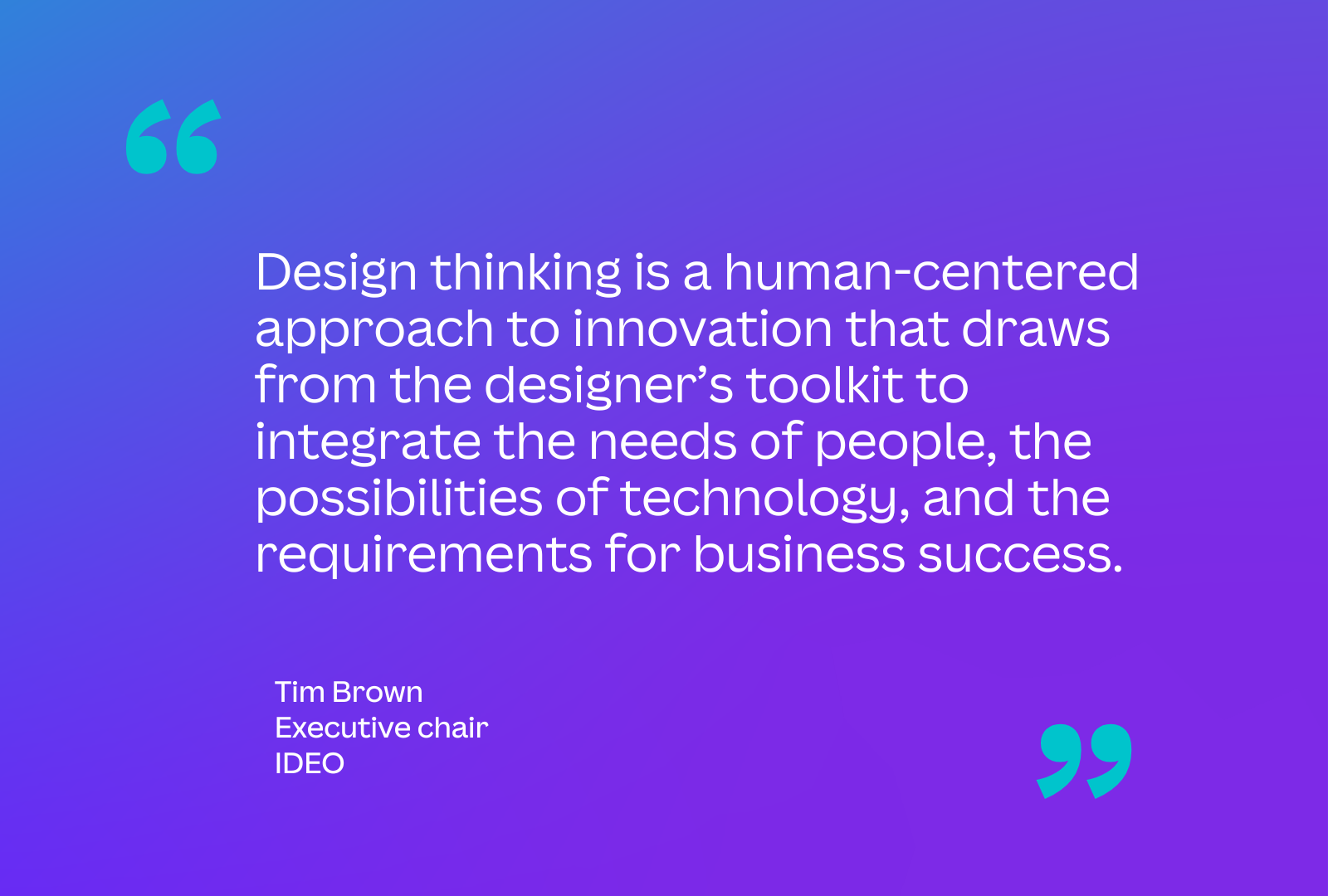
Brown and the team at IDEO understand that effective design thinking entails an observation that leads to insights. Those insights then lead to products and services that make a positive impact on the lives of our society.
The goal of improving lives is an important endpoint to the process of design thinking.
In fact, it’s what design thinking is all about: finding fresh, creative solutions to problems in a way that puts people and their needs first.
Design thinking came to the rescue for the organization selling treadle pumps in East Africa. It was able to identify why its product wasn’t selling in some regions, and it found a solution..but more on that, later.
The Design Thinking Process
The five stages of design thinking
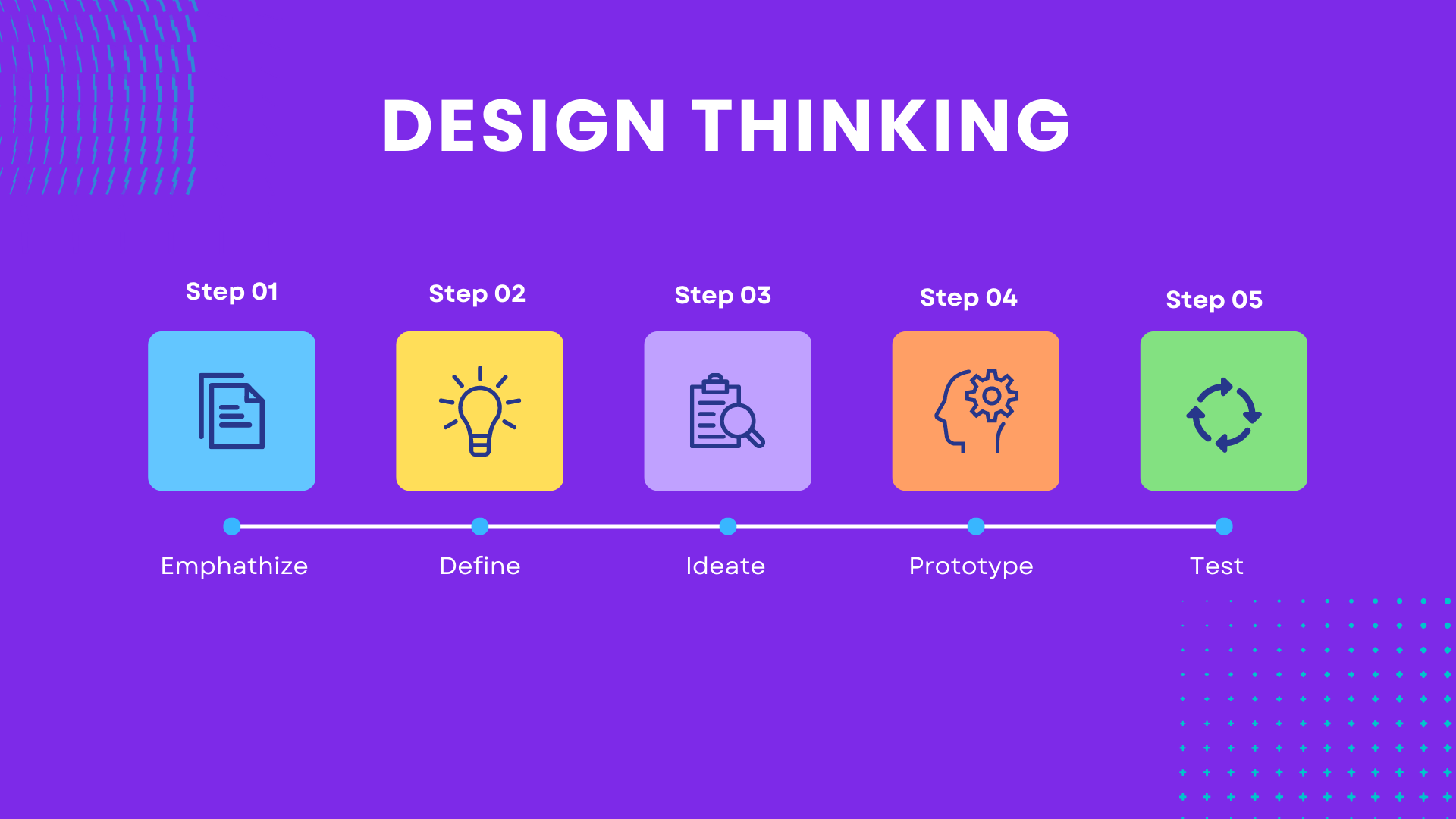
Design thinking is broken down into a cyclical series of five stages. It is a flexible methodology, with each step helping to counteract the biases that get in the way of innovation.
The five phases are:
- Empathize through observation
- Define the challenge
- Ideate as many ideas as possible
- Prototype a solution
- Test your work and iterate
1. Empathize through observation
The first phase in design thinking is to observe with empathy. Every problem has a unique context, one that’s defined by people. In design thinking, empathizing involves understanding the beliefs, values, and needs that make your audience tick. It involves observation—watching, listening to, and understanding your audience—and engagement—interacting with your audience, users, or customers.
To be effective in your design thinking, don’t just focus on your core audience. Conduct user research, interview new customer segments, and discover edge cases that you can observe and learn from.
Embed yourself in the lives of those you seek to help. A combination of observation and interviews is very important in this phase. If you can’t meet in person, request photos and videos of what is happening in their life to give you more context before the interview.
Then you can go into a conversation with a better understanding and more empathy. As a result, not only will you connect with human beings, but you will also ask the right questions at the right time.

For our company in East Africa, the empathizing phase revealed that the cultural norms in the regions where pump sales were high were different from the norms in the regions where pump sales were low. The observation process revealed that in the regions where sales of the treadle pumps were low, there were cultural norms that made it inappropriate for women to sway their hips in public (a key feature of the operation of the treadle pumps).
2. Define the challenge
In phase two, process what you’ve learned from your audience; compile it into insights, connections, and patterns; define the challenge you’re facing; and move toward potential solutions. What does all the information you’ve collected have in common, and what does it say about your audience and what they need?
In design thinking, this process is described as establishing a point of view (POV): a problem statement that sums up the insights you’ve learned about your audience and clarifies their human needs. The solution(s) you eventually come up with will be informed by this POV.
One effective way to define your challenge is to ask a question based on your observations. Frame the question clearly without putting any solution within your question. Think about who you are trying to help, what their need is, and what impact the answer to that question will have.
Going back to our treadle pump example, the question you might pose is: “How can we design a pump that does not require women to sway their hips?” or “What needs to change about this product to be within the cultural norms of this region?”
3. Ideate as many ideas as possible
The Ideate phase is a brain dump of ideas, and nothing is off limits. Come up with as many possibilities as you can. Like any other brainstorming session(opens in a new tab or window), aim for quantity over quality. After getting your ideas out, you’ll separate the good ideas from the bad until you find the “perfect” solution.
One of the main qualities of the Ideate phase is that it’s collaborative and participatory. The underlying point here is that everyone is creative in their own way—the brainstorming process can only benefit from having as many minds and perspectives as possible united in tackling the same problem.
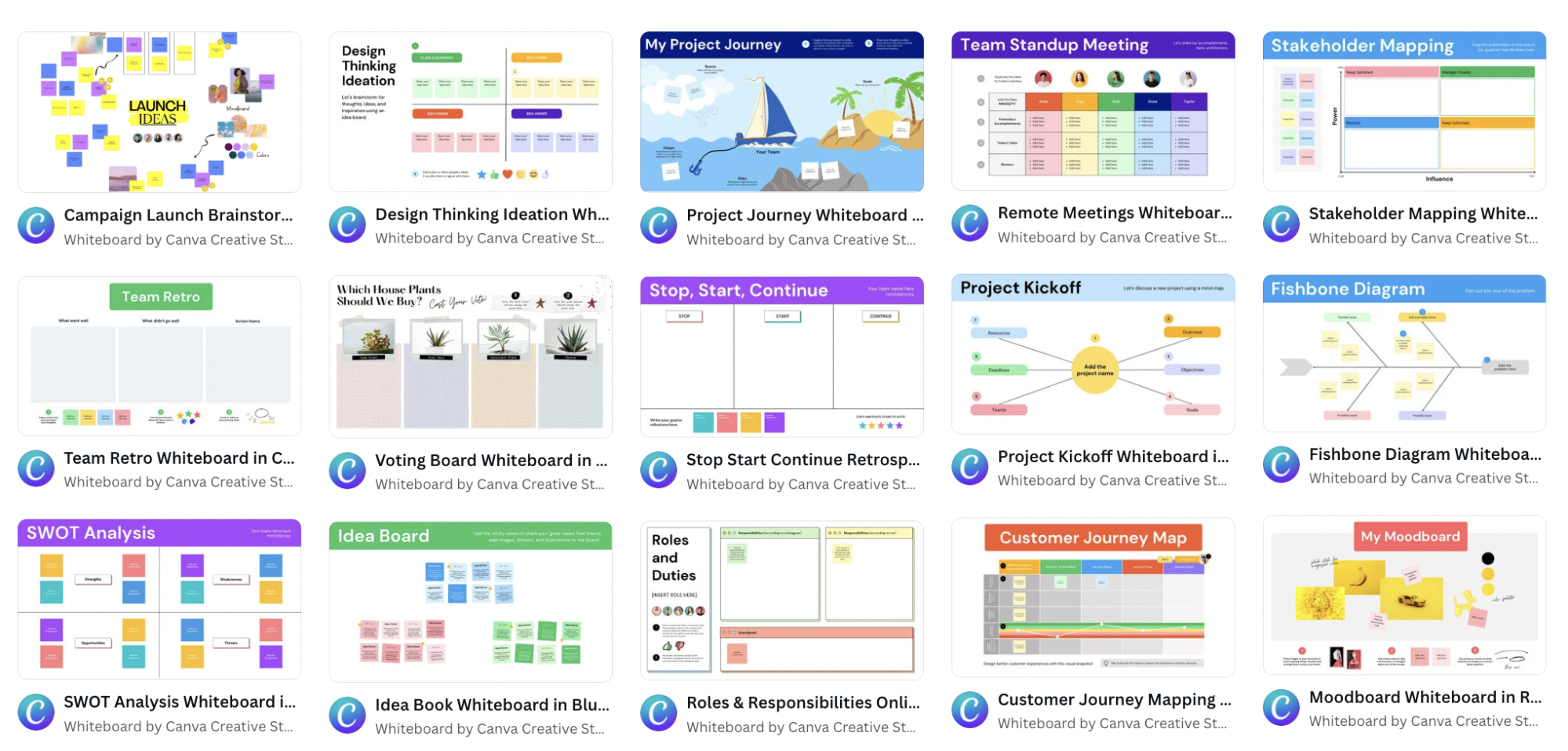
You can use visual collaboration tools(opens in a new tab or window) such as whiteboards to brainstorm your ideas:
If you lead a remote team, you’re in luck! Clustering ideas and voting on them tends to be easier for remote teams. The caveat is that the facilitator needs to keep up the energy and motivation.
That means giving assignments ahead of a brainstorming session so that people are more invested in contributing and finding innovative solutions.
Looking for inspiration to kick off your brainstorming sessions?
For our company in East Africa, the ideation process involved design team members contributing ideas for how to build or design a pump whose human operation didn’t rely on the swaying of the user’s hips. Eventually, the team settled on the first idea they were ready to put to the test.
4. Prototype a solution
Depending on your project, the Prototype phase could consist of a wall of Post-it Notes, a storyboard, a physical/digital item, or an interactive activity. By building a prototype, you make your idea tangible so that when you share it with your audience or users, you’ll get quality feedback.
For example, if you’re designing a new app, you can use the smart mock-up tool(opens in a new tab or window) in Canva to test out how your design looks on a phone, tablet, or monitor.
Then you can share this more realistic looking mock-up with stakeholders and users to learn more about how to improve your design or idea.
According to IDEO(opens in a new tab or window), prototyping teams are 50% more likely to launch a new product or service to the marketplace.
One method of prototyping that tends to lead to better design results is ”parallel prototyping(opens in a new tab or window).” In parallel prototyping, team members receive the same template, brief, and/or constraints and create their own prototype.
Once everyone is ready, the team comes together to share what each has created. Through this innovation process, you can analyze the similarities and nuances that will help you iterate on the final prototype.
The process of building a prototype will likely help clarify the problem even more and offer new insights or new solutions that you hadn’t thought of before. In preparing for the final testing phase, it’s helpful if prototypes can be looked at or experienced by your audience or user for the purpose of requesting feedback.
5. Test your work and iterate
Testing helps you learn more about your possible solutions and more about your audience. Depending on how the testing pans out, it may lead back to any of the four previous phases; you may discover that you didn’t define the problem correctly, failed to ask the right question, or need to spend more time observing your audience. Or you might just need to refine the prototype a little. Most likely, testing will help you develop improved and/or advanced prototypes.
As with the Empathize phase, observing and/or listening to your audience is key here. Instead of explaining the prototype up front, let users experience it on their own. Observing this interaction will help reveal important insights about what works and what doesn’t. Then, encourage them to ask questions and give their feedback about the experience. Offering multiple prototypes for users to compare is another useful technique.
Any phase of the design thinking process can be repeated or redesigned as needed or taken out of order. It’s not meant to be a linear process but rather an iterative process in which you adapt to the unique requirements of individual environments and projects.
For our company in East Africa, the testing process eventually resulted in a treadle pump whose human operation didn’t depend on the swaying of the user’s hips. The team created resources in Canva to explain how to use the new treadle pump, and sales of the units soared.
In Canva, users can easily share their designs, for feedback and approval before shipping it out to print. In the case of the east african treadle pump company, the educational resources were shared with stakeholders and representatives in East Africa. They were able to provide feedback that improved the directions and ensured that the women who used the pump would understand easily.
How to apply the design thinking framework at work
There are four steps you can take to apply design thinking at your company or with your team.
- Put on your journalist hats. A good journalist knows how to effectively listen, ask the right questions, and stay unbiased. With this mindset, have conversations with everyone, not just those on your team or direct reports. In this way, you can discover the true problem or question that needs to be solved.
- Encourage education and practice. Implement small tasks throughout the day that incorporate design thinking skills. Sign your team members up for design thinking courses(opens in a new tab or window). Regularly ask your team if they notice a project or process where they want to try out design thinking.
- Set expectations for feedback loops. Your team should know that you will be testing and iterating as much as possible. Feedback is an important part of this process that should be expected and embraced.
- Be honest and open about mistakes. During your many feedback sessions, you’ll inevitably need to be honest about what went wrong. Encourage and celebrate failures. Emphasize that failure leads to learning which leads to better solutions.
Design thinking is responsible for improving or developing new businesses, products, and services. Great design thinkers have a bias toward action. When you apply these four actionable steps to your team, design thinking works to change people’s lives for the better.
Design thinking vs. traditional problem-solving
You don’t need to be a designer to do design thinking. Rather, design thinking is a mindset you and your team can adopt during brainstorming sessions. According to IDEO, the more frequently that teams brainstorm(opens in a new tab or window), the more likely they are to achieve their objectives(opens in a new tab or window). When you implement design thinking, it helps you take something ambiguous (like a complex problem) and provide a clear and simple process to get to a solution.

Problem-solving methods similar to design thinking
There are various ways of applying elements of design thinking into a problem solving methodology. Flexibility in your design process can help you discover solutions if you get stuck on any one step of the design thinking process. For example, the Osborne Parness creative problem solving process is similar, but has four steps instead of five. While the IBM methodology has 7 steps.
You can learn more about other methodologies, including Canva’s design process methods in the video below.
For the company selling treadle pumps in East Africa, the solution didn’t surface after an analysis of the problem itself—low sales. It wasn’t found after an eight-hour corporate brainstorm in a New York high-rise with people in suits debating over charts and economic forecasts. The solution was born from a deep level of observation of the people who weren’t buying the pumps and the cultures they were a part of.
Creating a work culture around design thinking
If you want to gain the benefits of design thinking, you need to implement a work culture that supports it. Design thinking does not work if your company has a culture of fear or a culture of “no.” In those environments, people are scared to take risks, share unconventional ideas, or change the usual brainstorming processes.
You can demonstrate the importance of design thinking with the marshmallow challenge(opens in a new tab or window), a simple and playful design exercise. It allows your company members to discover the importance of the iterative design process through their own experience.
Another way to introduce design thinking to the skeptics and stakeholders in your office is to use storytelling.
If you need to persuade others in your workplace about the benefits and importance of innovation, use stories or case studies(opens in a new tab or window) that will inspire others and promote intrinsic motivation. It’s hard to stay skeptical about the power of human connection and innovation when you see the work put into action and the results making an impact.
The key is to start small but tell big stories. Incorporate design thinking on a smaller scale, and after achieving success, craft a story that highlights the impact you made. And don’t forget to mention that it all started with design thinking.
FAQs about design thinking
What is meant by design thinking?
Design thinking is a unique method of problem-solving that focuses on user needs first. Those who use design thinking do not need to be designers. It emphasizes observing people and their environments with empathy and using those observations to develop innovative ideas with an iterative, build-and-test approach.
What are the 5 core design principles?
As mentioned earlier in this guide, you don’t need to be a designer to partake in design thinking. However, depending on your project, it can be helpful to know some design principles for when you are in the ideate and prototype phases. They are as follows:
- Balance: Makes the design visually appealing. The visual weight of a design needs symmetrical, asymmetrical, or radical balance.
- Alignment: Gives a sense of order and direction for the viewer or user to navigate the page, product, or design.
- Proximity: Communicates a message about the elements in view. A close proximity suggests relatedness or connection, while a far one does the opposite.
- Repetition: Produces a feeling of organization and consistency that the viewer or user can depend on.
- Contrast: Makes the image, element, or product “pop” by setting it apart from the rest of the design, which keeps things interesting and draws attention to the right place.
Is design thinking an agile approach?
Yes. Design thinking is a mindset that acknowledges there is not one way to tackle problems. It is therefore an agile, human-centered design approach that allows your business to pivot as needed.
Are design thinking and Scrum the same?
No. Scrum is a method for the continuous improvement of complex products. Design thinking is meant to solve complex human-centric problems.
Is design thinking a mindset?
Yes. With design thinking, you approach a situation with an experimental, hopeful, and innovative mindset that focuses on the person or user experience.

Written by
Shani Leead